


How The Great Gatsby Musical Reinvented a Classic (and Why It Matters)
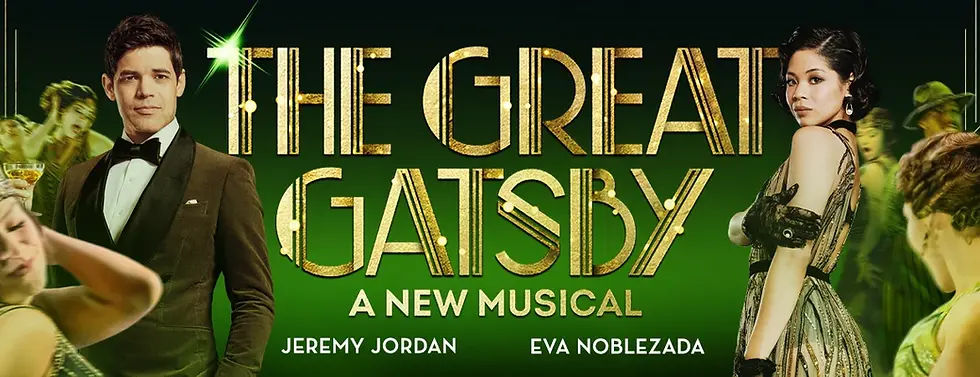
I approached "The Great Gatsby" musical with excitment. Not just because Kaite Kerrigan who wrote the book is a friend of mine. Not just because I am a fan of Jeremy Jordans' (who was Gatsby when I saw it) and not just because I snagged amazing tickets at a reasonable price.
F. Scott Fitzgerald's novel has weathered countless adaptations, film, television, ballet, opera, immersive theater, and even a computer game. Each has tried, with varying degrees of success, to capture the ineffable quality that makes the novel continually resonate. So when I heard Broadway was taking a swing at this American classic, I was weary and intruiged.
After experiencing the production, I've been thinking deeply about why this particular adaptation succeeds where so many others have faltered, and what it tells us about the relationship between classic texts and contemporary art.
The brilliant stroke of this production isn't that it faithfully recreates the novel, it's that it doesn't try to.
Instead, it uses the musical form to excavate the emotional undercurrents of Fitzgerald's work, creating something that feels both reverential and boldly original.
The decision to have Gatsby and Daisy's scenes swirl with lush, romantic orchestrations while Nick's narrative moments are accompanied by more dissonant, jazz-influenced compositions brilliantly underscores the novel's tension between romance and critique, illusion and reality. It's a musical language that doesn't just tell the story, it interprets it.
What fascinates me most is how the production engages with the novel's most challenging aspects. Fitzgerald's prose is famously lyrical, with passages of such beauty that they resist translation to other mediums. Rather than awkwardly forcing these passages into dialogue or lyrics, the production finds visual and musical equivalents, moments where lighting, choreography, and orchestration combine to evoke the same emotional response as Fitzgerald's prose.
The musical also confronts the novel's moral ambiguity head-on.
In an era where audiences often demand clear heroes and villains, the production maintains the complex moral landscape where Gatsby can be simultaneously admirable and deluded, where Daisy can be both victim and perpetrator. This moral complexity conveyed through songs that shift perspectives and undermine their own assertions feels startlingly contemporary.
Perhaps most importantly, the production understands that "The Great Gatsby" isn't just about the 1920s, it's about American identity itself. By incorporating subtle musical motifs from contemporary American genres alongside period-appropriate jazz and popular music, the score creates a conversation between past and present. It suggests that Gatsby's story isn't confined to the Jazz Age but continues to play out in American culture.
This approach to adaptation raises fascinating questions about how we engage with classic texts. The best adaptations aren't taxidermy, they don't seek to preserve the original in amber, unchanged and untouchable. Nor are they mere updates that discard what makes the original distinctive. Instead, they create a dialogue between past and present, finding new resonances and connections.
The Gatsby musical succeeds because it understands that adaptation is fundamentally an act of translation, not just from one medium to another, but from one cultural moment to another. It asks not "How do we faithfully reproduce this novel?" but "How does this story speak to us now? What does it have to say about our current American moment?"
This approach matters because it points to how classics remain vital. When adaptations treat source material as sacred and unchangeable, they paradoxically render it lifeless, a museum piece to be admired but not engaged with. By reimagining Gatsby through the lens of contemporary musical theater, this production argues that classics aren't static monuments but living texts that continue to evolve as we bring new perspectives to them.
The production's success also challenges the false dichotomy between artistic integrity and accessibility. Some purists might argue that making Gatsby sing and dance inherently diminishes its literary value. But what I witnessed was a production that made the novel's themes and emotions accessible to new audiences without simplifying its complexity.
In an age of endless reboots and adaptations, the Gatsby musical offers a template for how to approach classic material with both respect and imagination. It reminds us that the greatest respect we can pay to cultural touchstones isn't to freeze them in time but to keep them in conversation with the present.
As I left the theater, I overheard a teenager telling her friend that she now wanted to read the novel. That, perhaps, is the ultimate achievement of this adaptation, not replacing the original but creating a new entry point to it, ensuring that Gatsby's green light continues to beckon to new generations.
The musical doesn't try to be the definitive Gatsby, it understands there's no such thing.
Instead, it offers one compelling interpretation that enriches rather than replaces our understanding of the novel. In doing so, it demonstrates how classics remain vital, not despite being reimagined for new forms and audiences, but because of it.
Of course I need to mention Jeremy Jordan. His turn as Jay Gatsby was amazing. His vocal and emotional range, incredible. I was lucky enough to see him perform again, about 3 weeks after seeing him in Gatsby. He did a cabaret style show telling stories and singing songs. During that show, 1 of my closest friends was "randomly chosen" (but really it was planned) from the audience to come up and have Jeremy sing to her. What she didn't know, was that her amazing boy friend had planned the ultimate marriage proposal. And there is something to be said about the irony in this. Gatsby, facilitating the greatest act of love between 2 people. The act he never got to have, but always wanted. Jeremy was a good ol'sport for making such a magical moment for our friends.


Comments